The Stagnation Contract: Spatial Policing, Performative Neighbourliness, and the Rural Panopticon
Introduction
Critical sociology has long investigated the mechanisms of state and corporate surveillance, tracking how bureaucratic apparatuses, digital data-brokers, and closed-circuit systems discipline populations [1]. Yet, less theoretical attention is paid to the decentralised, informal regimes of surveillance operating within rural and semi-isolated communities [2].
When examined through a critical lens, the romanticised rural idyll frequently functions as a "Potemkin village"—an illusion of community that conceals a rigid social architecture [3]. Drawing from a twenty-two-month residency within a contained rural settlement, this essay examines how localised power structures transform everyday social roles and labour into agents of conformity, enforcing an unwritten panopticon where community boundaries are maintained through subtle, exclusionary practices.
I. Structural Vantage Points and Occupational Gatekeeping
In densely populated urban environments, anonymity offers a degree of structural resistance against social policing [6]. Conversely, rural micro-societies are characterised by high visibility and dense relational networks [7]. Within this context, occupational roles that require physical access to private spaces or control over social commons acquire immense disciplinary power.
- Domestic Incursions: Occupations involving property maintenance, grounds keeping, and home services grant individuals routine, unhindered physical access to private boundaries, collapsing the traditional distinction between private sanctuary and public observation [12].
- The Commercial and Recreational Commons: Roles anchored in social hubs—such as the village shop, the public house, the bowling green, and local sports clubs—position individuals as permanent fixtures at the intersection of local communication flows, operating as central nodes of every local network [8].
- Curation of Belonging: By controlling access to shared physical spaces and communal activities, these localised actors transition from participants to regulators, actively patrolling who belongs and who is marked as an outsider [10].
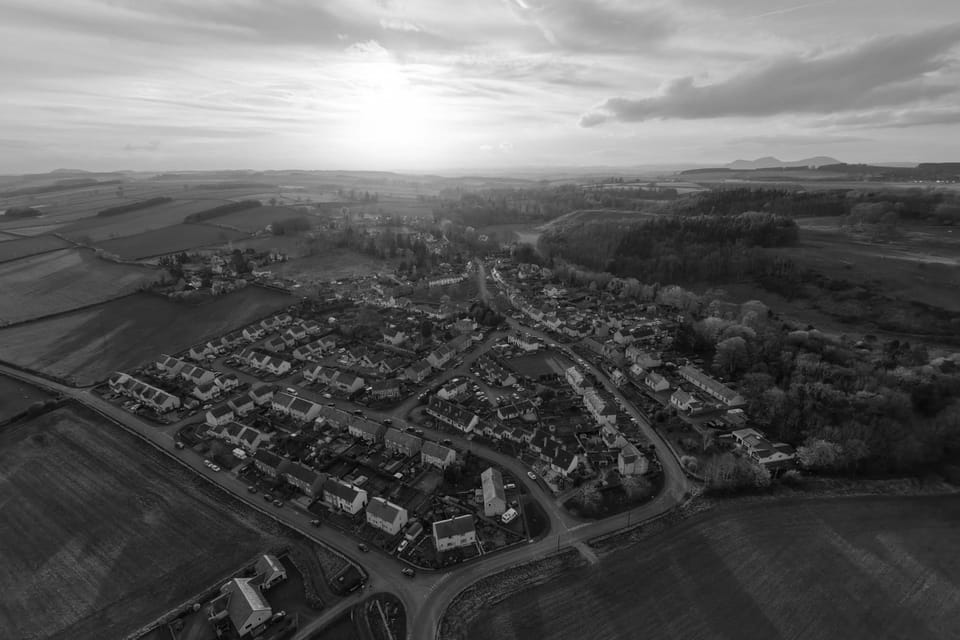
Geographically, these communities often exist as starkly contained islands of residential development abruptly bordered by vast, open agricultural land—a physical layout that naturally reinforces insularity and territoriality [5]. This compact spatial structure creates a powerful rural panopticon effect, where residents' daily actions are highly visible and subject to constant, unspoken communal surveillance [1].
II. The Clause of Performative Neighbourliness and the "Politeness Bias"
Beneath a surface layer of occasional neighbourly courtesy lies a pervasive undercurrent of social ostracism for those who do not seamlessly blend into the collective facade [4]. This dynamic is maintained through the Stagnation Contract, an unwritten code governing village life that can be broken down into four foundational clauses:
- The Clause of Performative Neighbourliness: All residents agree that "friendliness" shall be interpreted solely as the performance of public compliance [4]. Genuine engagement, open inquiry, or the challenging of local norms is strictly prohibited [10]. Failure to smile, wave, or participate in the mandated rhythm of the village is documented as "anti-social behaviour" [4].
- The Protocol of Mandatory Erasure: Should any resident express discomfort, question the "Stagnation Contract," or point toward the underlying mechanisms of village control, they are systematically transitioned into the status of "The Other" [10]. This process includes the professionalisation of gossip, the administrative complaint loop, and the intentional social vacuum [8].
- The Preservation of the Rural Idyll: The village idyll is not a living community; it is a static exhibition [3]. Any resident who introduces unauthorised ideas, modern analytical critiques, or disruptive transparency (such as independent documentation) breaches the contract and faces immediate social quarantine [10].
- The Guarantee of Collective Detachment: Residents practice "strategic ignorance" [2]. When the system acts to remove a disruptive element, residents maintain a collective silence, as acknowledging the torment of the outsider risks one's own standing within the contract [8].
This environment fosters a pervasive politeness bias—a tactical framework where challenges to established norms are dismissed as personal impoliteness or unfriendliness to avoid addressing legitimate structural concerns [4]. Within this closed ecosystem, superficial pleasantries are weaponised to obscure and invalidate structural hostility [10]. As an encapsulation of this dynamic, the remark that "this village has only ever been nice to you" highlights the underlying violence of a system where social etiquette is demanded from outsiders and enforced through the manipulation of public and private space [5].
III. Territoriality, Defensive Architecture, and the Inverted Panopticon
Foucault’s conceptualisation of the panopticon relies on architectural asymmetry—the central tower observing the peripheral cells, where the inmate internalises the gaze [1]. In the rural micro-panopticon, this architecture is inverted and decentralised [11]. There is no single tower; rather, every citizen-worker potentially doubles as a warden [1].
- Everyday Livelihoods as Surveillance Infrastructure: When daily survival, employment, and social life depend on maintaining local favour, community members internalise prevailing social norms, using the threat of social ostracism as an invisible disciplinary mechanism [11].
- Defensive Territoriality and Signage: The physical landscape reflects this psychological ownership [5]. Boundary markers, restrictive signage near public rights-of-way, and targeted alterations to public infrastructure serve as tangible expressions of defensive territoriality, framing outsiders as sources of contamination whose presence must be actively discouraged [9].
- The Board of Censors: Groundkeepers, local shopkeepers, and publicans effectively double as an unofficial board of censors, policing behavioural, intellectual, and political dissent under the guise of maintaining community standards [8]. Through projective identification, the collective anxieties and unspoken fears of the community are offloaded onto the outsider, re-framing their presence as an unwelcome blemish on an idealised world [3].
Conclusion
The rural micro-panopticon demonstrates that centralised control mechanisms do not require high-tech state infrastructure to be effective; they can be sustained entirely through the mundane distribution of local labour, spatial containment, and enforced cultural stagnation [1, 5, 9]. By recognising how everyday occupational roles, performative etiquette, and territorial boundary-marking are co-opted into systems of surveillance and censorship, critical sociology can better map the hidden power dynamics shaping contemporary rural life and articulate necessary methodologies for independent inquiry against the pressures of the unwritten panopticon [11].
Footnotes
- Michel Foucault, Discipline and Punish: The Birth of the Prison, trans. Alan Sheridan (New York: Vintage Books, 1975), 195–228.
- Shoshana Zuboff, The Age of Surveillance Capitalism: The Fight for a Human Future at the New Frontier of Power (New York: PublicAffairs, 2019), 17–35.
- Raymond Williams, The Country and the City (London: Chatto & Windus, 1973), 45–58.
- Erving Goffman, The Presentation of Self in Everyday Life (New York: Anchor Books, 1959), 35–48.
- Henri Lefebvre, The Production of Space, trans. Donald Nicholson-Smith (Oxford: Blackwell, 1991), 33–42.
- Louis Wirth, "Urbanism as a Way of Life," American Journal of Sociology 44, no. 1 (1938): 1–24.
- Georg Simmel, "The Metropolis and Mental Life," in The Sociology of Georg Simmel, ed. Kurt H. Wolff (Glencoe: The Free Press, 1950), 409–424.
- Antonio Gramsci, Selections from the Prison Notebooks, ed. and trans. Quintin Hoare and Geoffrey Nowell Smith (London: Lawrence & Wishart, 1971), 12–23.
- David Harvey, Spaces of Capital: Towards a Critical Geography (Edinburgh: Edinburgh University Press, 2001), 210–225.
- Pierre Bourdieu, Outline of a Theory of Practice, trans. Richard Nice (Cambridge: Cambridge University Press, 1977), 164–171.
- Michel Foucault, Power/Knowledge: Selected Interviews and Other Writings, 1972–1977, ed. Colin Gordon (New York: Pantheon Books, 1980), 146–165.
- John Berger, Pig Earth (London: Pantheon Books, 1979), 1–15.
Member discussion