The Biological Cage: Essentialism, Authoritarianism, and the Mechanics of Modern Exclusion

The contemporary political landscape is increasingly haunted by a familiar ghost: the reduction of complex human social realities to rigid, immutable categories. Whether manifested in the dogmatic policing of gender boundaries or the blood-and-soil tribalism of ethno-nationalism, a common theoretical mechanism is at play. Dominant political factions rely on a framework of biological essentialism to construct what can best be described as a biological cage—a conceptual and physical enclosure designed to restrict human agency, criminalise non-conformity, and enforce social hierarchy.
To understand this phenomenon requires moving past the superficial shouting matches of digital platforms and examining the underlying structures of power. When political movements weaponise essentialism, they are not merely debating definitions; they are engaging in authoritarian social engineering.
The Architecture of the Biological Cage
Biological essentialism operates by flattening historical, social, and psychological realities into deterministic absolutes. In the context of gender politics, this takes the form of reducing human existence to static physiological functions, treating biological observations as totalising moral or social destinies. As critics of this framework have frequently noted, the sleight-of-hand lies in converting descriptive statements of capability into prescriptive mandates of identity.
This mechanism mirrors historical patterns of authoritarian control. By framing social hierarchies as natural, immutable laws—whether based on sex, race, or lineage—gatekeepers attempt to render oppression unchallengeable. If a social arrangement is declared "natural," resistance is reframed not as political struggle, but as a violation of reality itself. This creates an intellectual prison where deviance from the essentialist norm is pathologized as a threat to civilisation.
The Captive Mind and the Far-Right Centrifuge
The psychic toll of this ideological machinery extends even to those who attempt accommodation with it. A striking feature of contemporary reactionary movements is the presence of the "captive mind"—to borrow Czesław Miłosz’s enduring framework—wherein individuals from marginalised or targeted groups volunteer to service the very apparatus built for their exclusion.
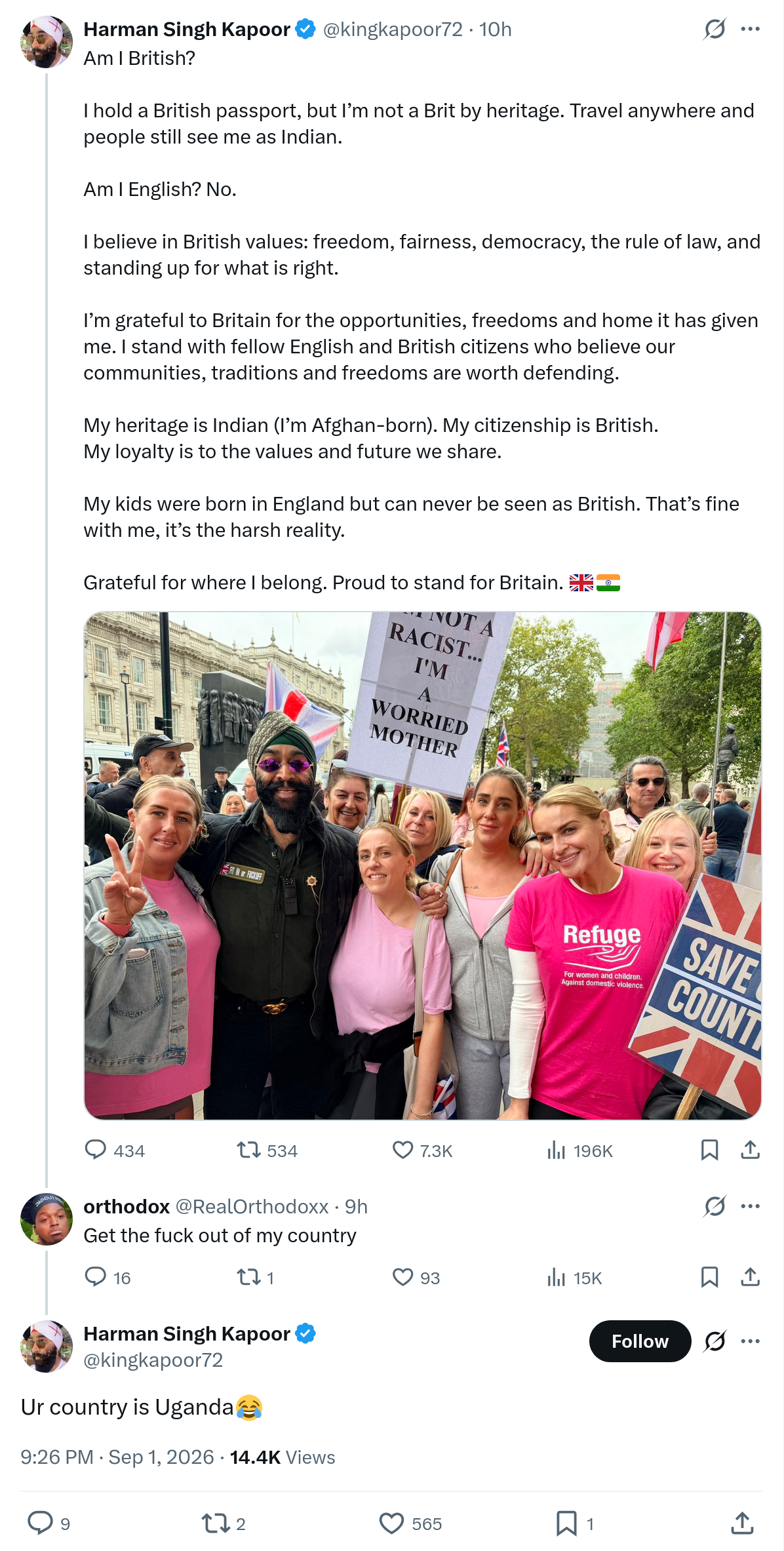
This dynamic is laid bare when individuals operating within the far-right orbit explicitly concede that their own children can never truly belong, yet embrace the movement regardless:
“My kids were born in England but can never be seen as British. That’s fine with me, it’s the harsh reality.”
To navigate the cognitive dissonance of marching alongside blood-and-soil exclusionists, the subject must internalise the oppressor's logic, accepting their own subjugation and conditional tokenism as an unalterable fact of life. The ideology acts as an internal warden, absolving the broader movement of needing external coercion because the subject has already learned to diminish themselves. Yet, as real-time digital interactions invariably prove, the perimeter of essentialist movements is absolute; the house pet is ultimately devoured by the very machine they sought to appease.
Corporate PR and the Spectacle of Inclusion
While ideological foot soldiers police these boundaries on social platforms, institutional actors busy themselves with damage control. When corporate bodies, healthcare authorities, or state bureaucracies face high-stakes legal tribunals over discriminatory practices, their immediate reflex is to deploy the theatre of inclusion.
Meetings with internal staff networks, glossy diversity pledges, and progressive public relations campaigns are rolled out precisely as structural crises loom. This corporate PR is transparently designed to manage liability rather than effect justice. It deploys the vocabulary of inclusion as a protective shield, masking institutional rigidity behind a veneer of corporate benevolence. The spectacle of institutional care functions as a smokescreen, hiding the ongoing enforcement of administrative and biological cages from public accountability.
Dismantling the Cage
Breaking the power of these essentialist frameworks requires refusing their foundational premises. Whether the discourse is framed around the policing of identity categories or the authoritarian demand for national and social purity, the objective remains the same: to make human freedom appear impossible.
Exposing the internal logical contradictions of gatekeepers—whether through minimalist intellectual provocation, historical contextualisation, or structural critique—serves to fracture their ideological coherence. The biological cage is not a law of nature; it is a human construct maintained through coercion, corporate insulation, and ideological compliance. Dismantling it requires naming its mechanisms, rejecting its false essentialisms, and refusing to accept the warden's terms as reality.
Member discussion