The Principality of Piddington: Anatomy of a Manufactured Moral Panic
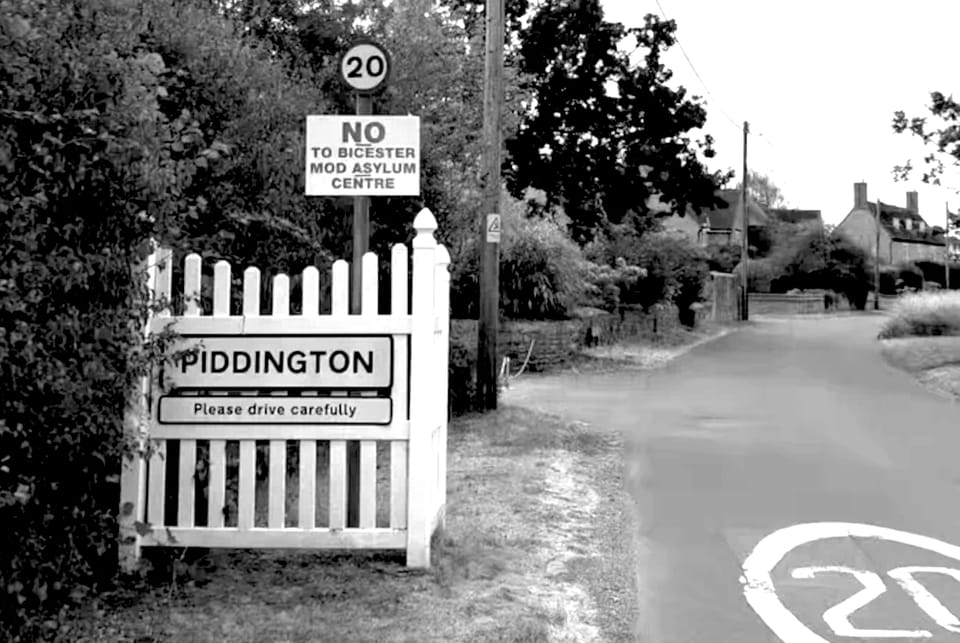
Recent events in the Oxfordshire village of Piddington have provided a striking masterclass in modern political theatre. Following opposition to a proposed asylum housing plan, residents staged a mock referendum, declared a symbolic secession from the United Kingdom, and hoisted banners for the self-styled "Principality of Piddington."
While mainstream media outlets and viral social media posts have treated the spectacle as a quirky local protest—complete with QR codes, human chains forming semi-circles on the village green, and breathless coverage from GB News and visiting populist figures like Rupert Lowe—the reality is far more insidious. Beneath the veneer of quaint village resistance lies a textbook exercise in far-right entrism, tactical moral panic, and xenophobia functioning as a secular political religion.
Xenophobia as a Political Religion: Rituals and Dogma
When exclusion is elevated to a political religion, a community no longer operates on rational arguments, legal justifications, or factual evidence; it runs entirely on dogma, ritual, and sacred geography.
The Piddington spectacle displayed all the classic liturgy of this modern faith:
- The Rituals: Synchronised human chains forming semicircles on the village green, holding hands around hand-painted wooden letters to spell out their brand, and staging mock secessionist ceremonies for drone cameras.
- The Dogma: An absolute, unshakable belief in an uncorrupted, native "purity" under existential siege by external contamination.
- The Clergy: Visiting political entrepreneurs like Rupert Lowe descending to deliver sermons, validate local grievances, and absolve the congregation of moral compunction.
- The Scapegoat: The asylum seeker, reduced from a human being fleeing horrific violence to an abstract pollutant whose mere approach threatens the theological order of the micro-state.
This political religion offers a potent, instant framework of belonging to people who are socially and spiritually starving. You don't have to face your own internal rot, neighbourhood micro-feuds, or the quiet collapse of your local civic fabric if you can enlist as a holy warrior defending the borders of a pop-up "principality."
The Theatricality of Secession: Weaponising Hyper-Localism
Declaring a breakaway "principality" over a government planning decision is a brilliant piece of surrealist political theatre. It co-opts the language of self-determination, sovereignty, and independence, inverting concepts historically used by oppressed groups to fight for liberation and applying them instead to exclusionary protectionism.
By wrapping themselves in mock-medieval statehood, the residents bypass administrative reality. Westminster is not going to issue passports for the Principality of Piddington. But that was never the point. The performance serves a dual psychological purpose:
- Sanitising the Rhetoric: As seen in social media commentary rushing to defend the residents as "upper-class liberal residents" rather than extremists, the theatrical framing attempts to launder raw xenophobia through respectable demographics. Property protection, heritage preservation, and "common sense" are deployed as linguistic shields against the "far-right" label.
- Externalising Internal Friction: For communities running on high levels of internal surveillance, petty micro-feuds, and self-policing social codes, pointing a finger outward provides an intoxicating release valve. The jubilation, cheering for the cameras, and synchronised human chains act as a collective holiday from their own internal toxicity, uniting neighbours against an abstract, externalised scapegoat.
Tactical Entrism on Wedge Issues
Piddington illustrates how modern far-right politics operates through decentralised entrism. Rather than marching under explicit party banners, the strategy relies on infiltrating local governance structures, neighbourhood networks, and planning disputes, using a wedge issue like immigration as a crowbar.
Housing and displacement are classic wedge issues because they instantly bypass institutional nuance and trigger visceral, hyper-local anxieties. By framing asylum seekers not as human beings fleeing extreme violence and persecution, but as an existential criminal threat to local culture, the architects of these panics manufacture a perpetual siege mentality.
Visiting political entrepreneurs swoop in to validate these grievances, transforming a local zoning dispute into a front-line dispatch for a wider cultural crusade. It turns the village green into a makeshift rally stage, plugging hyper-local insularity directly into national populist circuits.
The Cosplay of Resistance: Preserving the Static Ideal
The profound absurdity of the stunt is laid bare the moment the television crews pack up and the visiting agitators drive away. A visit to the official village website reveals absolute silence—no proclamations of independence, no border decrees, just the uninterrupted preservation of a static ideal: notices about local walking trails, bus stop book exchanges, and parish maintenance.
The grand secession is pure political cosplay. The participants get to pull on the costume of the embattled rebel, play out a cinematic fantasy of resistance, and then comfortably snap back into the legal, administrative, and municipal safety of the very system they pretended to overthrow. They do not want an actual breakaway state; they want the aesthetic of defiance without consequences, folding right back into a static ideal where the bin collection runs on time and the village signpost remains polished.
The Grim Irony of Sanctuary
The deepest tragedy of these spectacles is the human cost at the centre of the storm. Refugees flee unimaginable oppression, surviving perilous journeys across borders, only to land in the crosshairs of domestic political theatre and hostile environments that treat their very survival as a contamination.
Handing over the moral and legal definition of sanctuary to a self-appointed village council or a pop-up "principality" is a complete inversion of justice. It reduces a humanitarian duty to an arbitrary, exclusionary referendum where empathy is absent from the ballot.
Conclusion
The Principality of Piddington is ultimately a stage play—a temporary escape valve for a self-toxifying micro-society playing dress-up as freedom fighters in a secular religion of exclusion. But the consequences are real. When local planning disputes are weaponised to fuel national moral panics, the vulnerable pay the price, while the architects of the panic pack up their cameras and move on to the next village green.
Member discussion