Anatomy of a Grievance Industry: Dissecting the Logic of LabourLGB

A recurring feature of contemporary political discourse is the rapid transmutation of political lobbying into performance art. In recent exchanges across independent critical spaces, interactions with platforms like LabourLGB offer a textbook case study in how exclusionary movements construct their rhetorical architecture. What begins as a dispute over institutional access quickly collapses into a predictable loop of bad-faith deflection, semantic gymnastics, and what can only be described as a cult of inverted victimhood.
The Flight from Substance to Statutory Shields
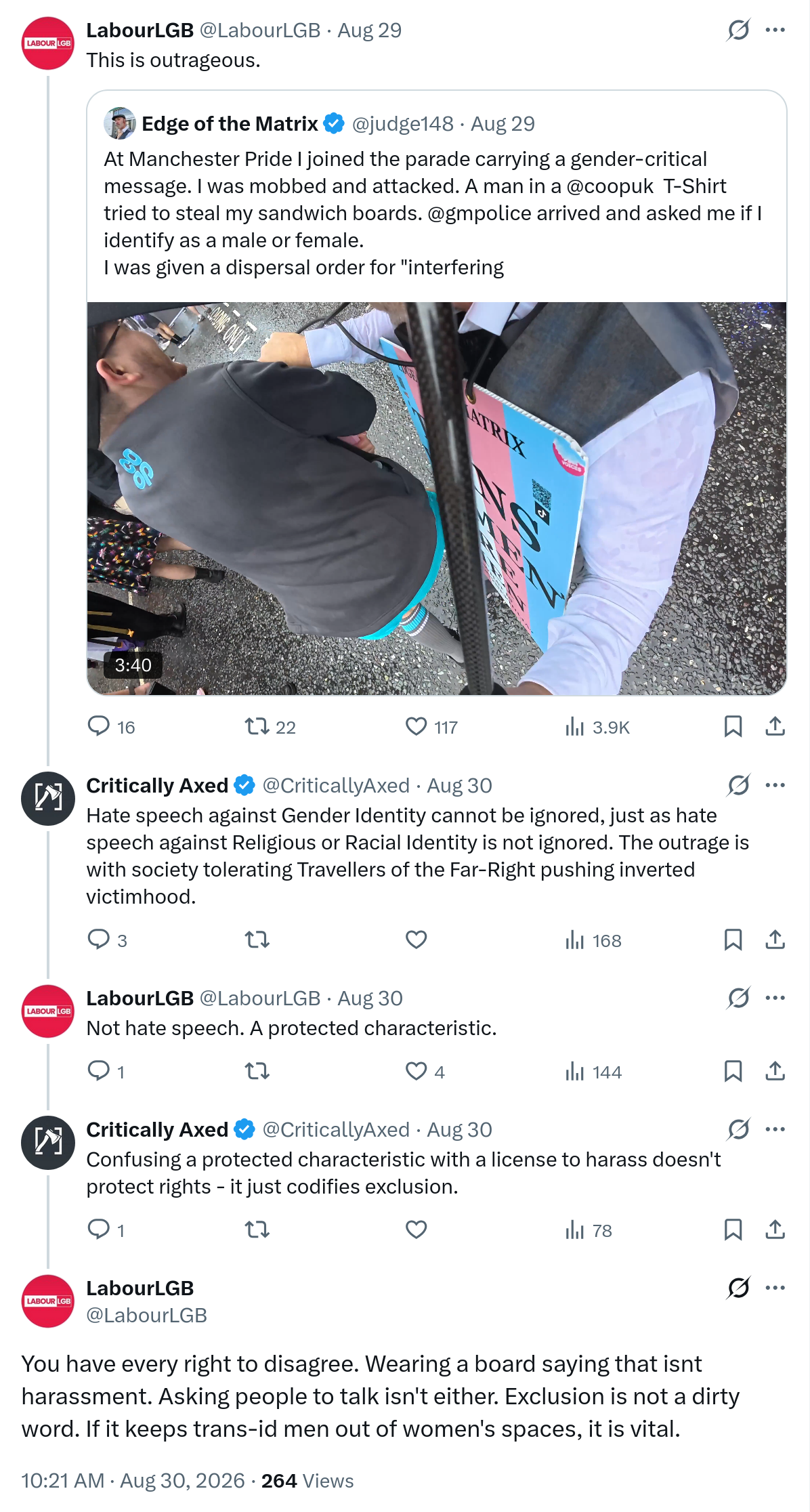
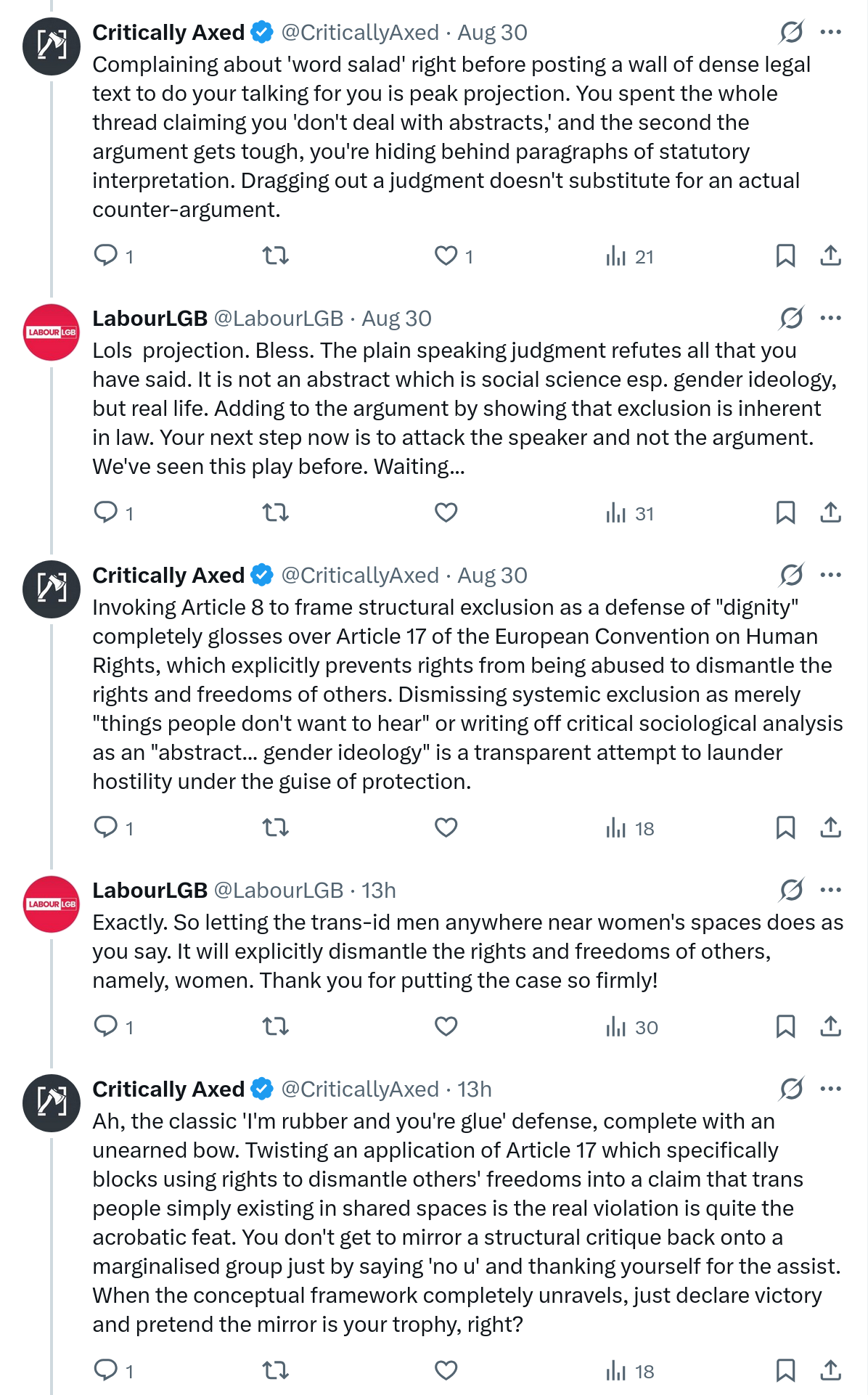
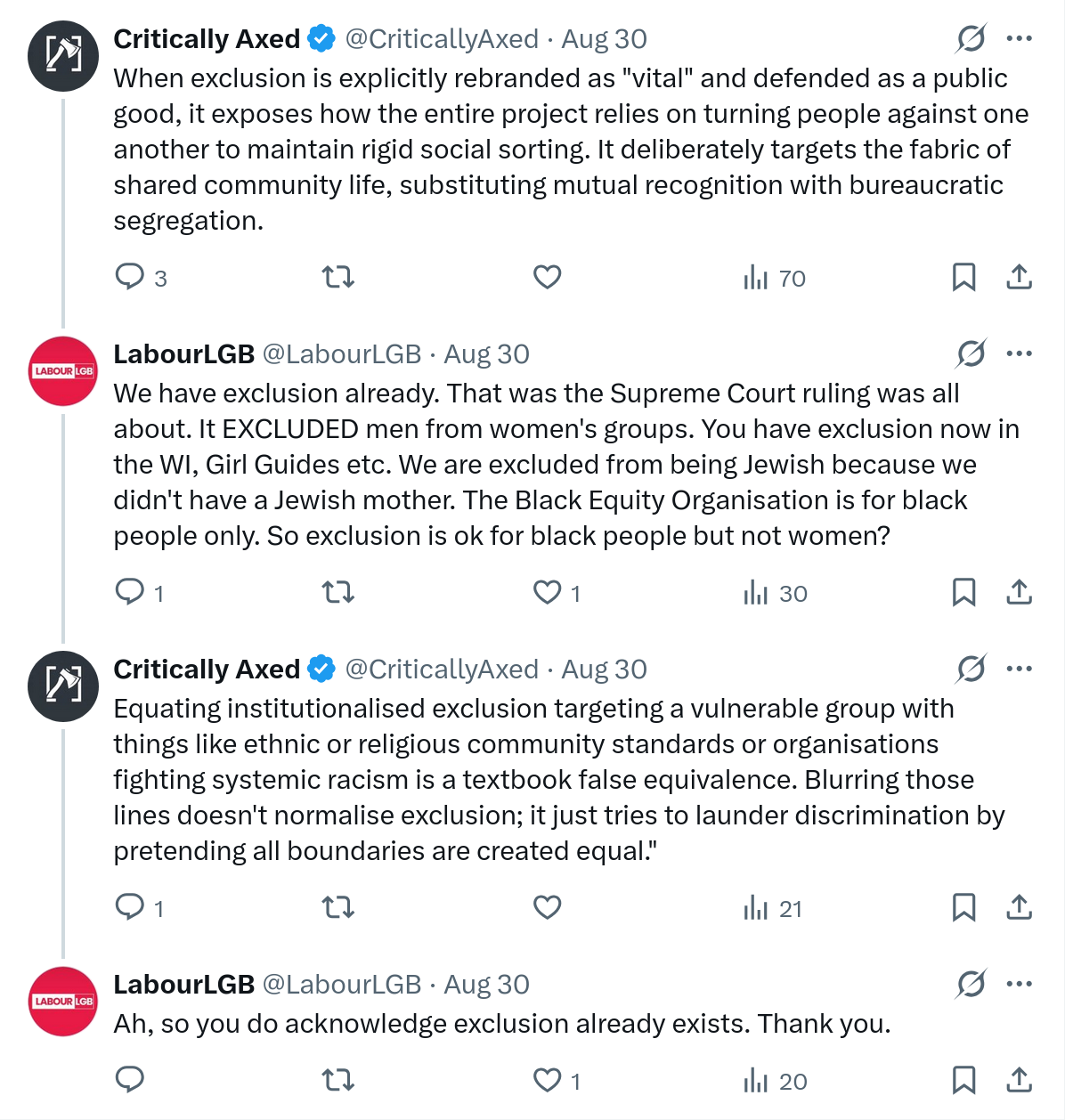
A defining characteristic of these exchanges is an immediate resistance to conceptual critique, met with a swift pivot to literalist statutory defence. When structural frameworks or human rights intersections (such as Articles 8 and 17) are raised, the counter-argument relies heavily on asserting that exclusion is a "vital" public good necessary to protect women's spaces.
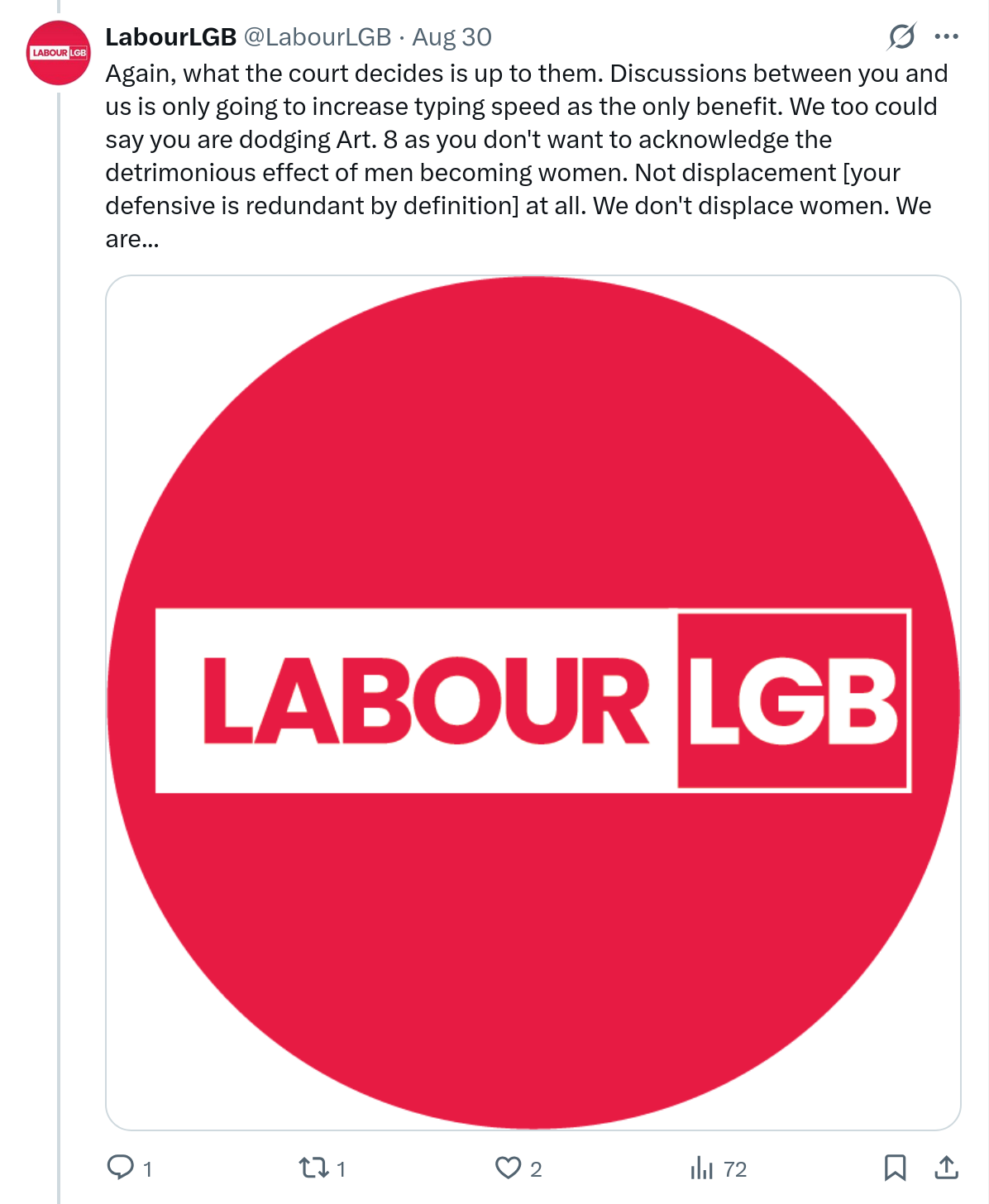
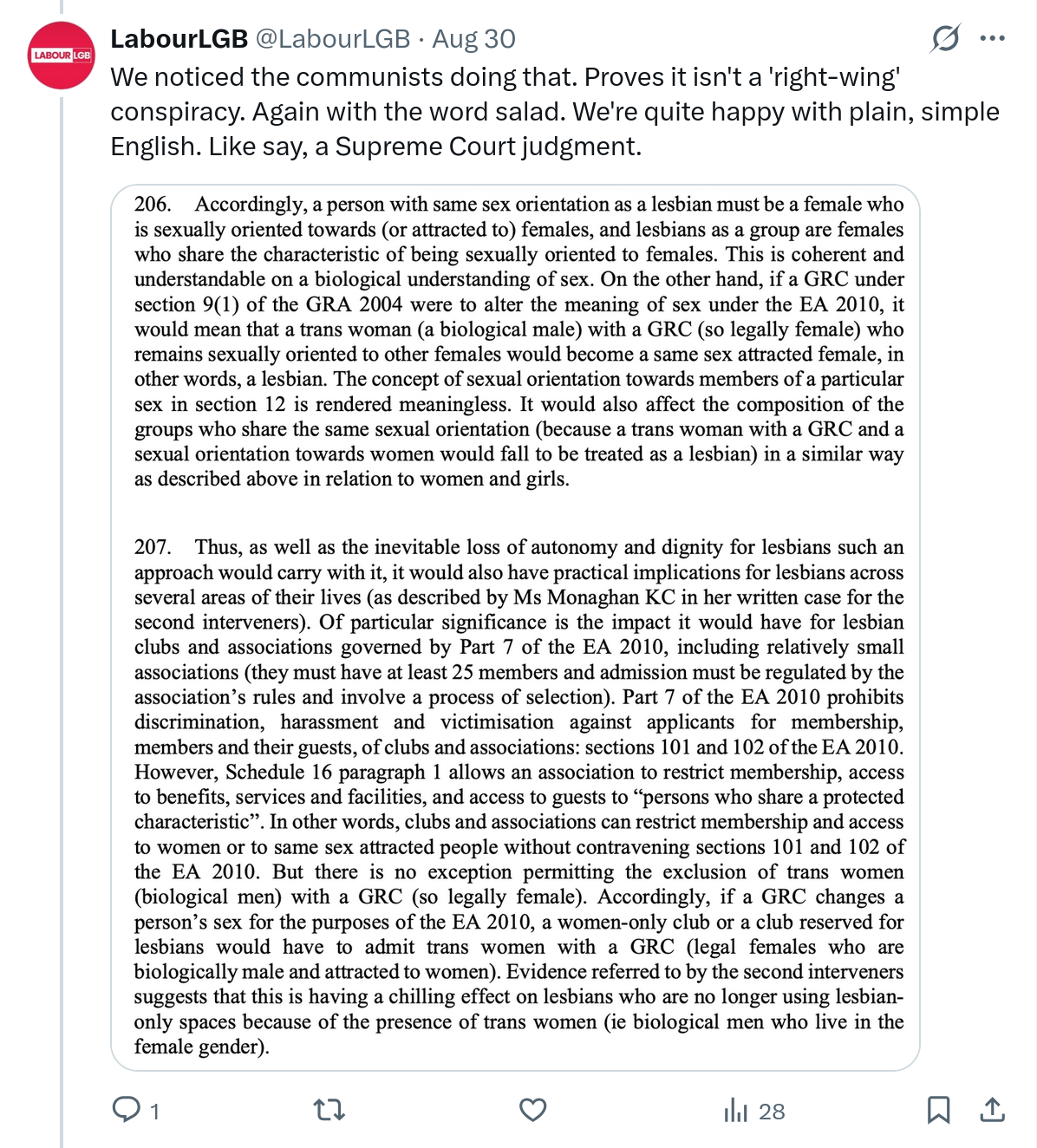
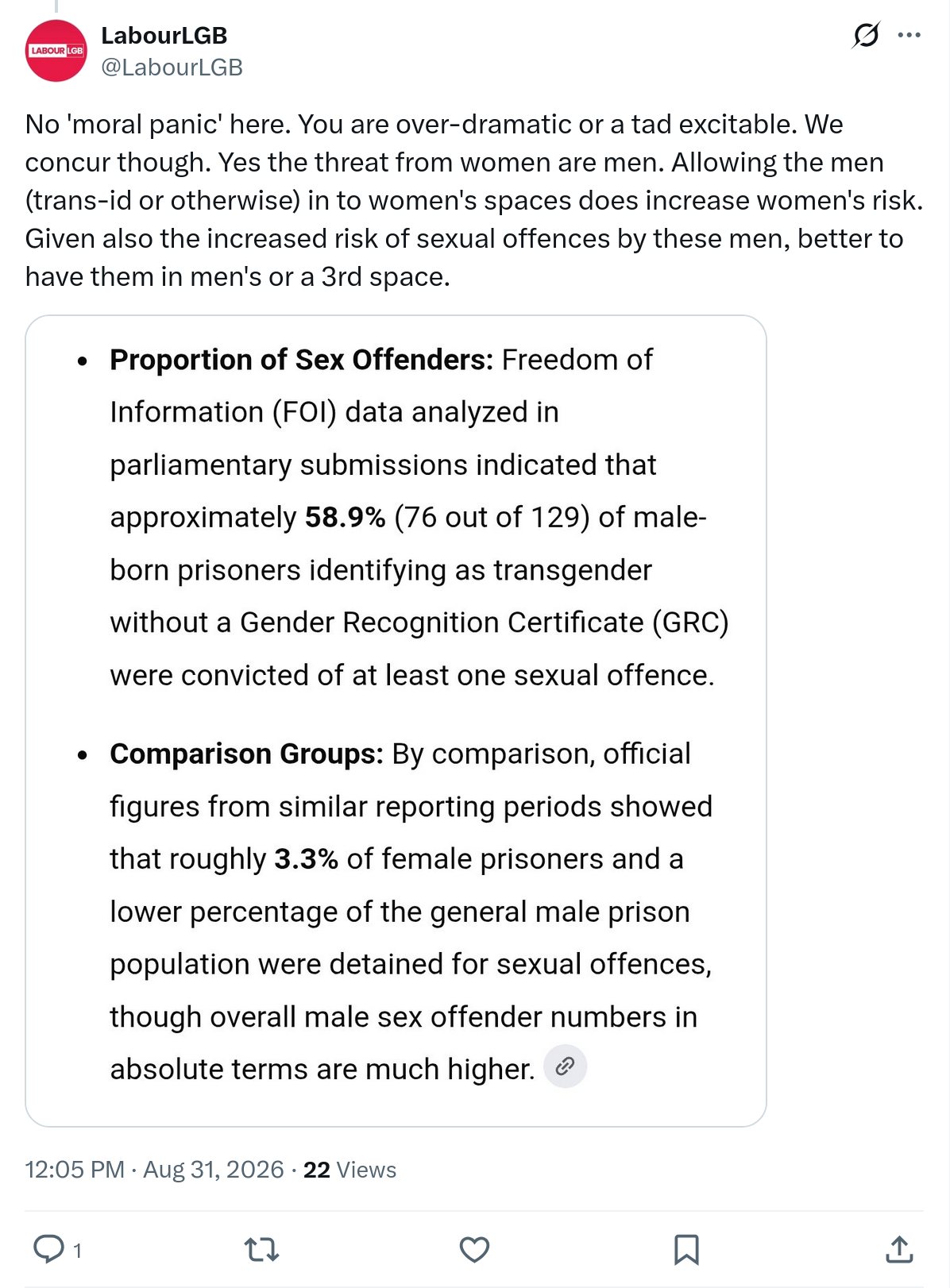
Yet, when pushback highlights the broader implications of these rigid binaries, the discourse undergoes a sharp tactical shift. Abstract engagement is abandoned entirely in favour of dumping dense blocks of text and Supreme Court excerpts into the thread. Statutory interpretation is deployed not to illuminate a nuanced principle, but to serve as a conversational deadbolt—substituting legal walls for actual dialogue while dismissing discussion as merely increasing typing speed.
The Cult of Inverted Victimhood
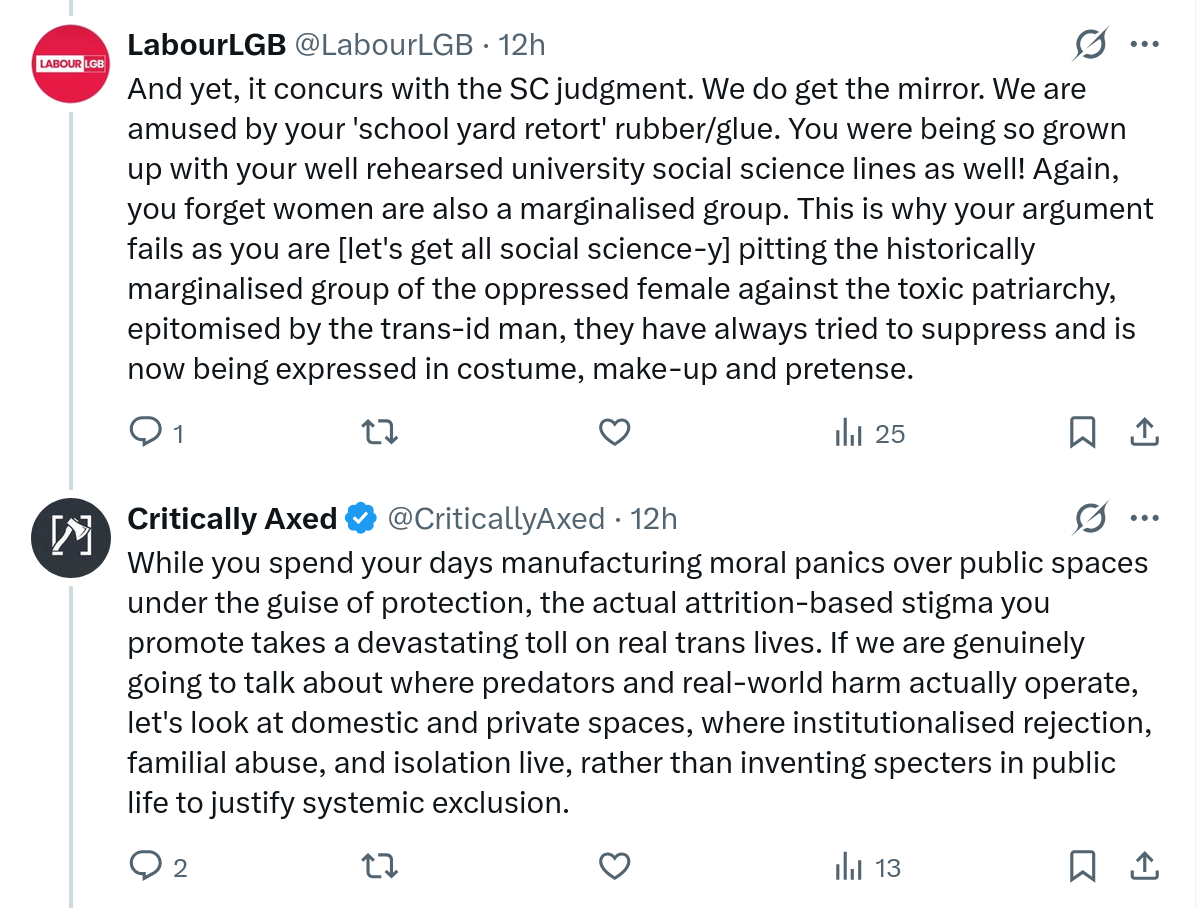
Perhaps the most potent mechanism at play is the systematic inversion of power dynamics. Figures operating within this milieu demand all the tactical benefits of advocating for systemic exclusion while instantly adopting the posture of the persecuted minority the moment they face conceptual pressure.
The Reflexive Persecution Complex: Any pushback against exclusionary ideology is met with immediate accusations of "hate speech," "violence," or "death references" over figurative language like a "chopping block".
Escalation and Misdirection: When cornered conceptually, discourse is dragged into severe false equivalencies—equating the institutional exclusion of a marginalised minority with communal self-definition, religious lineage rules, or historical equity organisations like the Black Equity Organisation. Furthermore, it extends to absurd personalisation, such as accusing an interlocutor of being "inherently violent" simply because their profile picture features a stylised graphic of an axe.
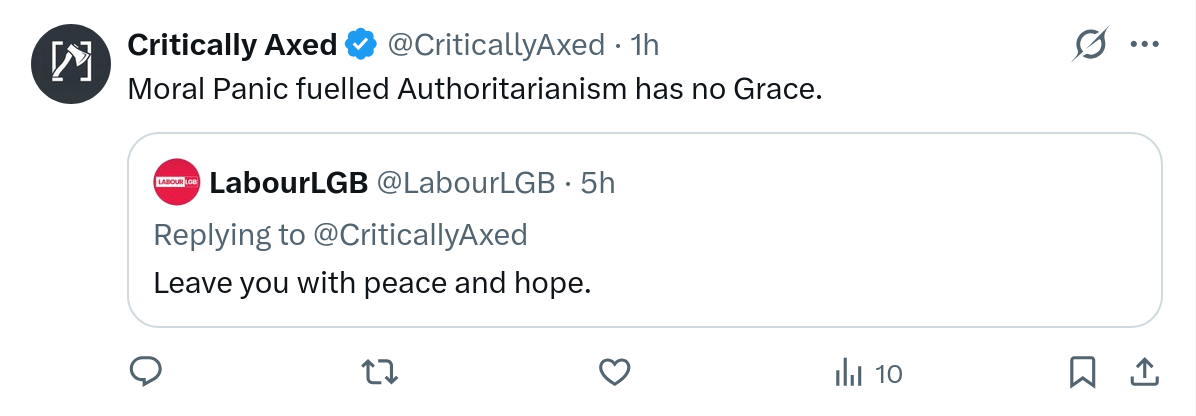
The Retreat to Imagery and Evasion: When the argument stalls entirely, the discourse degrades into pure theatre—abandoning text to drop giant corporate-style logos mid-thread or cutting off mid-sentence, ensuring that ideological branding substitutes for engagement.
Laundering Exclusion as Protection
The core ideological engine driving these platforms relies on a linguistic sleight of hand: systematic exclusion is rebranded as a vital defence of dignity. By insisting that "exclusion is not a dirty word" when applied to keeping trans people out of shared spaces, they attempt to normalise structural sorting while simultaneously crying foul and declaring themselves victimised whenever their categories are cross-examined.
Toward an Inclusive Framework
Clearing away the rubble of manufactured panics and exclusionary dogma requires shifting the paradigm away from boundary-policing and toward a liberated horizon:
Material Safety Over Gated Boundaries: True security is built through collective welfare, robust social infrastructure, and stable housing, directly addressing actual sites of harm—such as domestic and private spaces—rather than scapegoating marginalised groups in public life.
The Right to Autonomy and Opacity: Rejecting the authoritarian demand that everyone conform to rigid, state-enforced binaries for the comfort of bourgeois respectability and administrative neatness.
Solidarity as a Practice: Replacing competitive grievance loops with active, intersectional solidarity that recognises the interconnected nature of all struggles against oppression.
The discourse peddled by groups like LabourLGB ultimately reveals a movement running entirely on defensive displacement. Stripped of its borrowed legal excerpts, metric-driven deflections, pearl-clutching accusations of violence based on profile avatars, and sudden retreats behind brand logos, the project is remarkably fragile. It is a politics built on grievance, sustained by amplifying external provocations, and terrified of structural critique because it cannot survive contact with it. When your entire political identity relies on policing who belongs while screaming victimhood from behind a graphic stamp, you aren't engaging in debate—you're just staging a retreat toward collective liberation.
Member discussion